
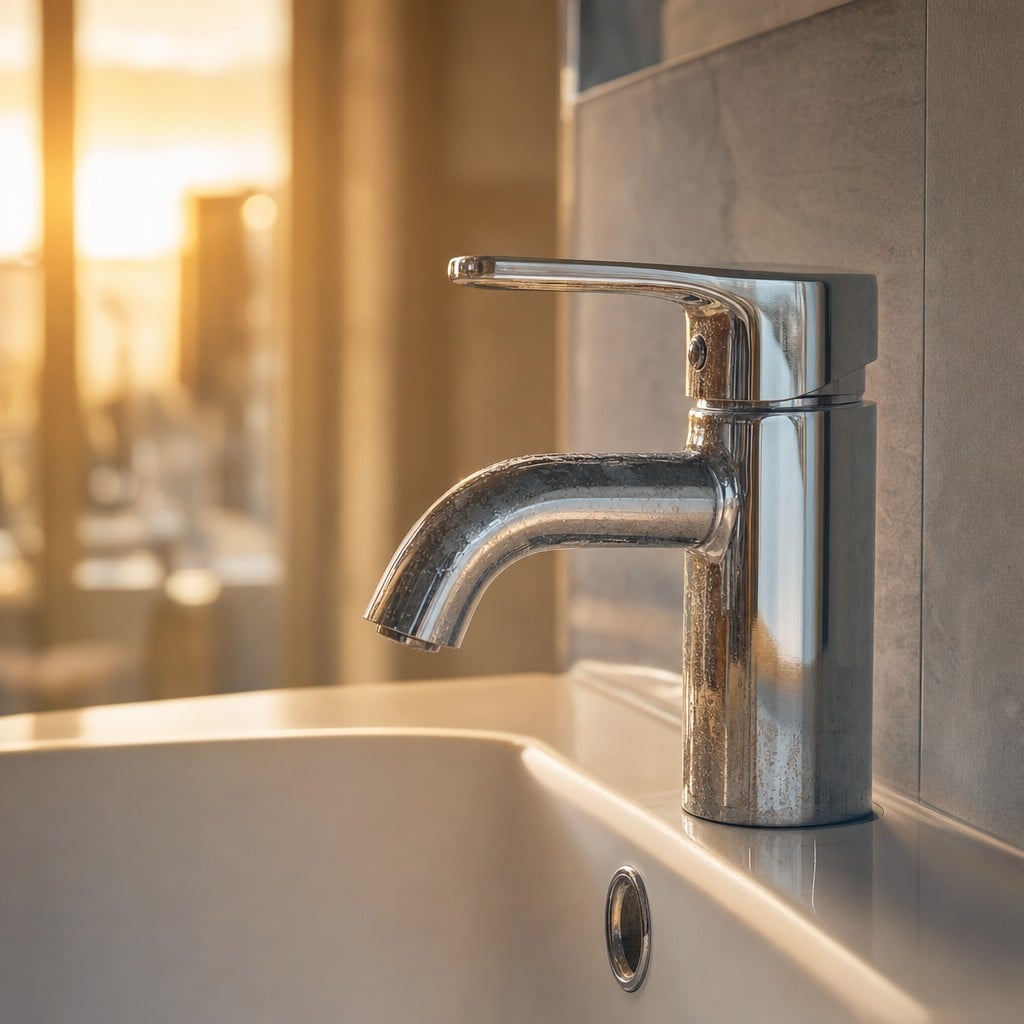
Why limescale accumulates in taps
In areas with hard water, limescale (calcium carbonate) deposits slowly in pipes and especially at the water inlet points of taps and mixers. These whitish deposits build up on seals, internal check valves and aerators, forming a crust that reduces water flow and forces the mechanism to work harder. Seals wear out faster, and the tap eventually leaks or stops working properly.
Regular descaling prevents premature replacement and keeps your installations in good working order.
Signs of a limescale-clogged tap
You will recognize a tap that needs descaling by several indicators:
- Reduced or irregular water flow
- Visible whitish deposits at the tap or mixer outlet
- Water coming out in bursts or in several streams instead of a uniform jet
- Unusual noises when opening the tap
- Seals that leak or drip for no apparent reason
How to descale yourself
Descaling the aerator
The aerator is the small grid at the tap outlet. It is the first area to get clogged with limescale.
- Unscrew the aerator by hand (it unscrews like a bottle cap)
- Rinse it under running water to remove debris
- Soak it in a glass of white vinegar or descaling solution for 30 minutes to 2 hours depending on the thickness of the limescale
- Gently brush with a small brush to remove residue
- Rinse thoroughly and screw back on
This operation is often enough to restore good water flow.
Descaling the mixer or complete tap
If the problem persists after descaling the aerator, limescale has accumulated upstream.
- Close the main water supply (main stopcock) or the local supply to the tap in question
- Open the tap to empty the pipes
- Apply white vinegar or specialized descaling product directly to the internal area: you can dampen a cloth and wrap it around the tap outlet, or use a plastic bag filled with vinegar that you keep in place for a few hours
- Let it work for 1 to 4 hours depending on the severity of the buildup
- Reopen the water supply and let it run to flush out the residue
- Test the flow
For thermostatic mixers or cartridges, intervention is possible but more delicate: it is sometimes preferable to replace the cartridge if it is completely blocked.
Recommended tools and products
- Standard white vinegar (economical, effective for light to medium limescale)
- Specialized chemical descaler (more powerful for thick deposits)
- Small soft-bristled brush
- Microfibre cloth or soft sponge
- Adjustable wrench if you need to disassemble the tap
- Protective gloves
Descaling frequency
In areas with hard water, descaling the aerator every 6 to 12 months is recommended. Complete descaling of the mixer can be done every 2 to 3 years or as needed.
Preventive descaling costs a few euros and 30 minutes. Replacing a limescale-clogged mixer at the end of its life costs much more and requires professional intervention.
When to call a plumber
If home descaling does not solve the problem, if the tap continues to run or leak after treatment, or if you are not comfortable dismantling your installation, we can intervene for diagnosis and repair or replacement.
Wk haustechnik, based at Geerenweg 16, 8303 Bassersdorf, advises you and handles all your plumbing needs. Call us at +41 79 558 84 30 or visit our site for more information.
For professional descaling, diagnosis or a quote for replacing your taps and mixers, come and see us or contact us directly.