
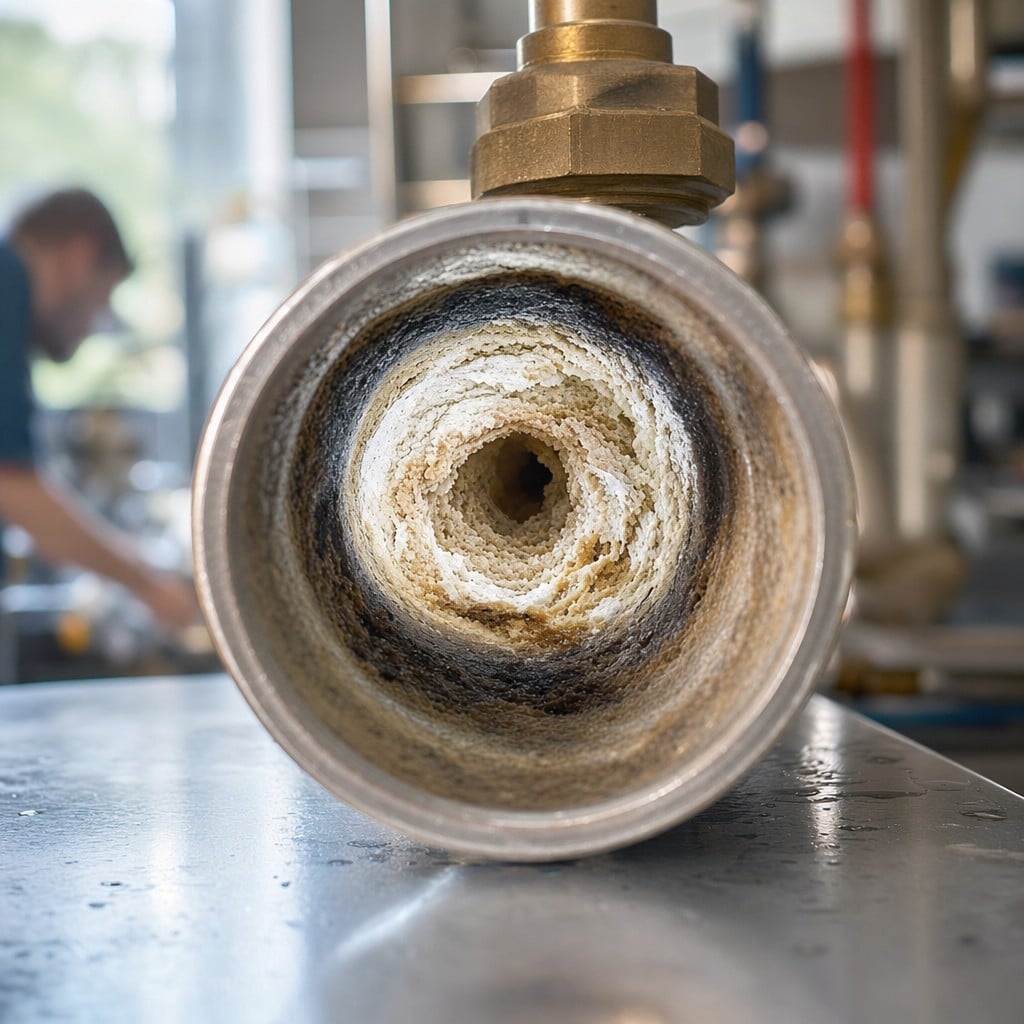
Limescale comes from tap water, particularly in French-speaking and German-speaking Switzerland where water hardness varies by region. As water flows through your pipes, limescale deposits progressively on the internal walls, forming a layer that reduces flow and can cause long-term problems. By understanding this mechanism and adopting a few preventive measures, you will significantly extend the lifespan of your plumbing system.
Why limescale accumulates in your pipes
Tap water contains minerals, mainly calcium and magnesium, which form limescale. When this water circulates through your pipes and heats up (particularly in hot water circuits), these minerals crystallize and adhere to the internal surface of the pipes. This accumulation progresses slowly but steadily, especially if your region has hard water.
This problem affects not only the pipes, but also:
- Faucets, whose seals and showerheads become encrusted
- Household appliances (water heaters, washing machines)
- Mixers and thermostatic valves
Visible consequences of limescale
Limescale is not just a cosmetic problem. You will gradually notice:
- A reduction in water flow at certain faucets or the shower
- An increase in noises in the pipes (water hammer)
- Higher water consumption for the same result
- White stains on faucets and seals
- Reduced lifespan of your water heater or heat pump
In advanced cases, limescale can partially or completely obstruct certain sections of pipes, requiring professional unblocking.
Simple steps to prevent accumulation
Maintain your system regularly
Preventive maintenance is your best defense against limescale. Rinse your faucets regularly with cold water after using hot water, and clean encrusted showerheads by soaking them in white vinegar for a few hours. For your water heater, an annual flush removes deposits that accumulate at the bottom of the tank.
Control the temperature
The hotter the water, the faster limescale forms. Set your water heater or radiator thermostat to a moderate temperature (around 55 to 60°C for hot water) rather than maximum. This slows limescale precipitation and also reduces your energy consumption.
Keep your pipes flowing
A pipe where water circulates regularly accumulates less limescale than a stagnant pipe. If you have sections rarely used, open the corresponding faucets each week to allow water to flow through.
Monitor your flow rate
If you notice a gradual decrease in flow at a faucet or shower, this signals limescale accumulation. The sooner you act, the simpler the unblocking work will be.
When to call a professional
When limescale has begun to obstruct your pipes, professional cleaning becomes necessary. WK Haustechnik, in Bassersdorf, has the proper equipment to remove deposits without damaging your pipes: hydromechanical unblocking, high-pressure cleaning, or chemical treatment adapted to the nature of your pipes.
The professional can also advise you on the opportunity to install a water softener if your region is particularly hard water, or on regular maintenance of your water heater and heat pump to prevent limescale from affecting the efficiency of these appliances.
Maintain your system over time
The key is consistency. Simple preventive maintenance every three to six months is enough to avoid major deposits. This includes:
- Cleaning faucet aerators
- Checking water pressure
- Visual inspection for leaks or wear areas
- Light unblocking if necessary
These simple and inexpensive steps will save you significantly on emergency calls and pipe section replacements.
Frequently asked questions
Can you remove limescale yourself with white vinegar.
White vinegar works well for small surfaces (faucets, showerheads, seals) and superficial deposits. For obstructed pipes or major accumulations inside the pipes, only a professional with specialized tools can intervene effectively and safely.
Is a water softener really useful.
It depends on your region's water hardness. A plumber can perform an analysis and recommend a softener if your water is very hard, particularly if you have a heat pump or water heater. The investment pays for itself over several years by reducing maintenance and extending the life of appliances.
How often should you maintain your system.
Annual preventive maintenance is recommended, particularly before the heating season if you have a boiler. In case of frequent blockages or noticeable flow reduction, faster intervention will be necessary. Contact WK Haustechnik at +41 79 558 84 30 to determine the maintenance frequency suitable for your system.